
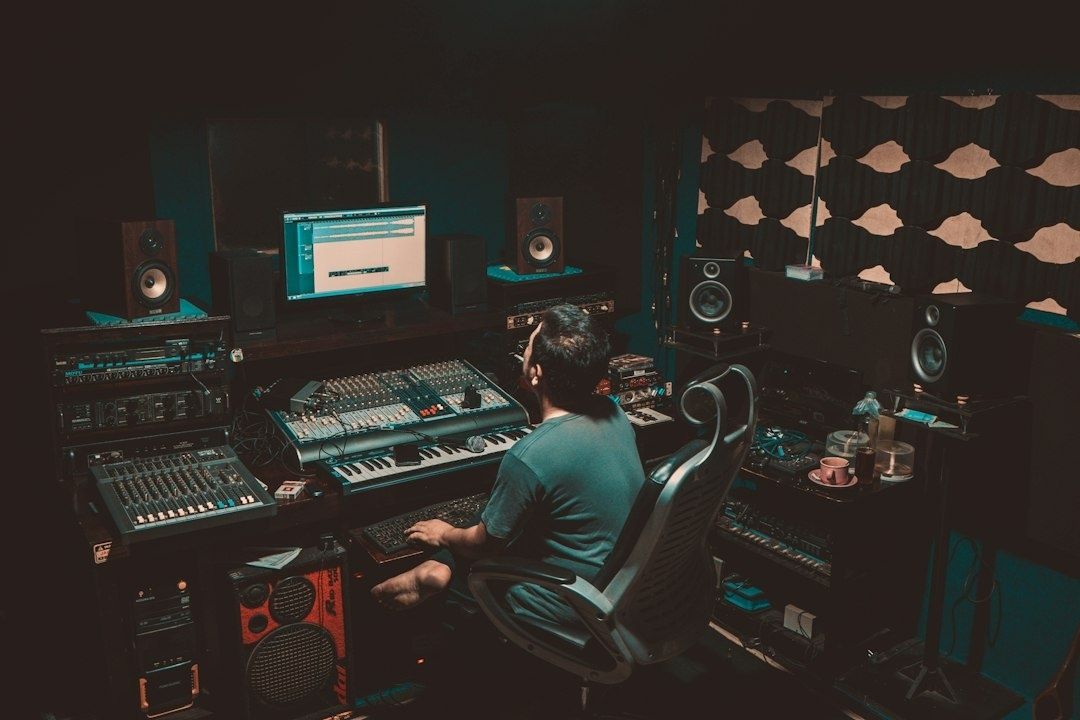
The Anatomy of the 40-Bar Trap
Every producer eventually meets the same apparently immovable boundary. The intro arrives, the central riff lands, the vocal idea finds its shape, and somewhere around bar 40 the session stops behaving like a song and starts behaving like a museum exhibit. The myth says the missing ingredient is inspiration, as if a more elusive muse is required to complete the record. In practice, the problem is usually more physical and procedural. Attention has been narrowed, choices have multiplied, and the brain is being asked to evaluate the same material long after its useful information has been extracted.
This is the condition often described as DAW loop-hypnosis. A section cycles so many times that harmonic movement becomes background texture. The ear stops hearing tension and release with precision, while the eyes keep scanning waveforms, plug-in windows, automation lanes, and unused instruments. Repetition no longer reveals the arrangement; it numbs perception. The way out is not to wait for a dramatic emotional rescue, but to dismantle decision fatigue. A 40-bar sketch becomes a finished record when its creator changes the conditions of listening, prototypes alternatives quickly, and removes material with enough confidence to let the essential narrative lead.

Cognitive Overload and the Mechanics of Producer Fatigue
A modern DAW is an extraordinary compositional instrument, but its abundance can become an invisible antagonist. Hundreds of soft synths, unlimited tracks, sample libraries, alternate takes, mix presets, and plug-in chains create the impression that the perfect answer is always one more search away. That abundance encourages horizontal thinking rather than forward motion. Instead of deciding whether the second chorus should open with a new bass movement, the producer auditions twelve bass sounds, adjusts six compressors, and revisits the first chorus for the ninth time.
The result is analytical paralysis. Early songwriting tends to reward instinct because the task is generative: find a contour, a rhythm, a lyric, or a harmonic color. Mid-stage arrangement is different. It requires comparison, prioritization, deletion, and commitment. Those are executive functions, and they degrade under sustained effort, insufficient sleep, poor breaks, and circadian pressure. Guidance from the American Academy of Sleep Medicine and the Sleep Research Society explains that fatigue is shaped not only by the length of a work period, but also by workload, prior sleep, time awake, time of day, and biological rhythms. The same principle applies in a late-night session, where an apparently minor arrangement decision can begin to feel impossibly consequential.
The physiology of effort offers a useful parallel. Research on Exercise metabolism and adaptation in skeletal muscle examines how sustained demands interact with biological thresholds and recovery. A studio session is not a workout in the literal sense, but the broader lesson is relevant: performance changes as resources are consumed, and pushing harder does not guarantee better decisions. Treat the session as a sequence of focused efforts rather than one heroic, uninterrupted ascent.
- Reduce the number of active decisions by freezing or hiding nonessential tracks.
- Separate writing passes from sound-design and mix passes.
- Use short listening breaks before judging a repeated section.
- Stop making structural decisions when every option begins to sound equally plausible.
Subtractive Architecture to Resurrect Stagnant Demos
Subtractive arrangement is the most direct antidote to a crowded session. Begin by muting the foundational rhythm track, whether that means the programmed drums, the main guitar pattern, the arpeggiator, or the loop that established the demo. The purpose is not to punish the original idea. It is to force the remaining parts to reveal their independent identity. A counter-melody that was previously buried beneath a busy groove may suddenly suggest a pre-chorus. A vocal phrase may expose an unexpected pause. A chord layer that seemed supportive may prove to be the entire emotional center.
This method also changes the producer’s role. Instead of asking what can be added to make the section feel larger, ask what is preventing the section from moving. The answer may be a low synth duplicating the bass, a percussion loop competing with the vocal consonants, or a pad that erases the contrast between verse and chorus. Stripping secondary VSTs from the session can expose the essential chordal and vocal narrative, much as a reduced arrangement on an early demo sometimes carries more character than its polished successor.
| Arrangement condition | Typical symptom | Subtractive response |
|---|---|---|
| Additive clutter | Every section has the same density | Mute duplicate parts and restore contrast |
| Rhythmic masking | Vocal phrasing feels trapped inside the groove | Remove or simplify the foundational rhythm |
| Harmonic fog | Chords sound wide but emotionally indistinct | Retain one defining chord voice and remove layers |
| Timbral indecision | Several instruments perform the same function | Choose one lead, one support, and one transition sound |
| Static dynamics | Verses and choruses arrive at the same intensity | Subtract elements before the verse and reintroduce them selectively |
A useful triage pass can be brutally simple. Solo the vocal, the principal harmonic instrument, and the lowest supporting part. If the song still communicates its mood and direction, the core is intact. If it does not, additional production will rarely solve the problem. Rewrite the phrase, change the voicing, or alter the silence around it. Subtraction is not a visual clean-up exercise; it is a test of whether the record has a readable center.
Tactical Frameworks for Forcing Structural Progress
When a loop has become too familiar, change its identity before judging it again. Tempo-agnostic experiments are particularly effective because they separate the composition from its current playback habit. Stretch the section dramatically, then listen for a half-time architecture. Double the perceived pulse and identify whether a new chorus emerges. Transpose the material by a semitone or whole step, even if the result is only temporary. A key change can expose melodic habits that were invisible in the original tonic, while metric disruption can reveal where the arrangement is relying on repetition rather than development.
The objective is not to keep every experiment. It is to generate evidence quickly. A producer stuck at bar 40 does not need another hour of subtle refinement; the session needs a decisive collision with alternatives. Save each version clearly, preserve the original, and judge the variations away from the edit cursor. The strongest arrangement may not be the most comfortable one on first listen. It may be the version that introduces a little friction, creates a new pocket, or gives the lyric enough space to become memorable.
- Minute one to three Identify the exact bar where forward motion stops, then duplicate the session or save a new version.
- Minute four to six Mute the main rhythmic foundation and extend the vocal, chord, or melodic material beyond the existing loop.
- Minute seven to nine Create three rapid variations: half-time, double-time, and one transposed version. Do not mix them.
- Minute ten to twelve Build a rough post-40-bar section using only the strongest available parts, even if the transition is crude.
- Minute thirteen to fifteen Choose the version with the clearest momentum, print a rough bounce, and write down the next three edits instead of reopening every decision.
Incubation is the second half of this process. Once a structural question has been framed clearly, step away from the monitor. A walk, a meal, a change of room, or a night of sleep can interrupt the loop that kept returning to the same assumptions. The psychological concept of incubation in creative problem-solving describes how a break from conscious effort can allow less obvious associations to form. The break is not avoidance when the problem has already been specified. It is a deliberate change in cognitive mode.
Arranging Under Oblique Constraints
Artificial limits are often more productive than unlimited freedom. Restrict the arrangement to four primary stem groups, such as drums, bass, harmony, and voice. Every new sound must either replace a member of one group or justify its existence as a transition. This forces function to become audible. A distorted texture may survive because it defines the chorus entrance; a beautiful pad may disappear because it merely occupies the same emotional territory as the vocal.
Oblique strategies, associated with Brian Eno’s approach to breaking habitual decision patterns, can be adapted without treating them as mystical instructions. Ask the bass to play the rhythm of the vocal. Reverse the order of two sections. Remove the first chord of every phrase. Let the percussion enter only during the vocal gaps. Start the bridge with the sound that normally appears at the end. These constraints bypass predictable chordal progressions and familiar production reflexes. During rough tracking, momentum matters more than polish. Preserve the emotional drive, print imperfect passes, and resist turning every promising accident into a technical correction.
- Limit the active arrangement to four primary stem groups.
- Give each section one clear function, such as tension, release, contrast, or aftermath.
- Use one oblique instruction when a progression feels predictable.
- Print rough takes before editing away their urgency.
- Reserve detailed automation and tonal sculpting for the committed structure.
Commit Your Arrangement and Print the Track
Finishing music is a learned discipline, not a reward granted only when inspiration remains uninterrupted. The first idea supplies the spark, but iteration supplies the architecture. Every completed record contains decisions that could have been revised indefinitely. The professional difference is not the absence of doubt; it is the ability to recognize when another option will add information and when it will only prolong the loop.
Take one stalled demo today and impose a finish line. Mute its foundation, build one rough section beyond bar 40, test a radical tempo or key variation, and reduce the session to its essential stems. Then print the arrangement. Commit the decision, close the plug-in search, and listen to the bounce away from the screen. A printed track turns an infinite workspace into a tangible object, which is precisely what breaks loop-hypnosis. The goal is not to protect the sketch from imperfection. It is to give the song a complete form that can finally be heard, judged, and improved as a record.