
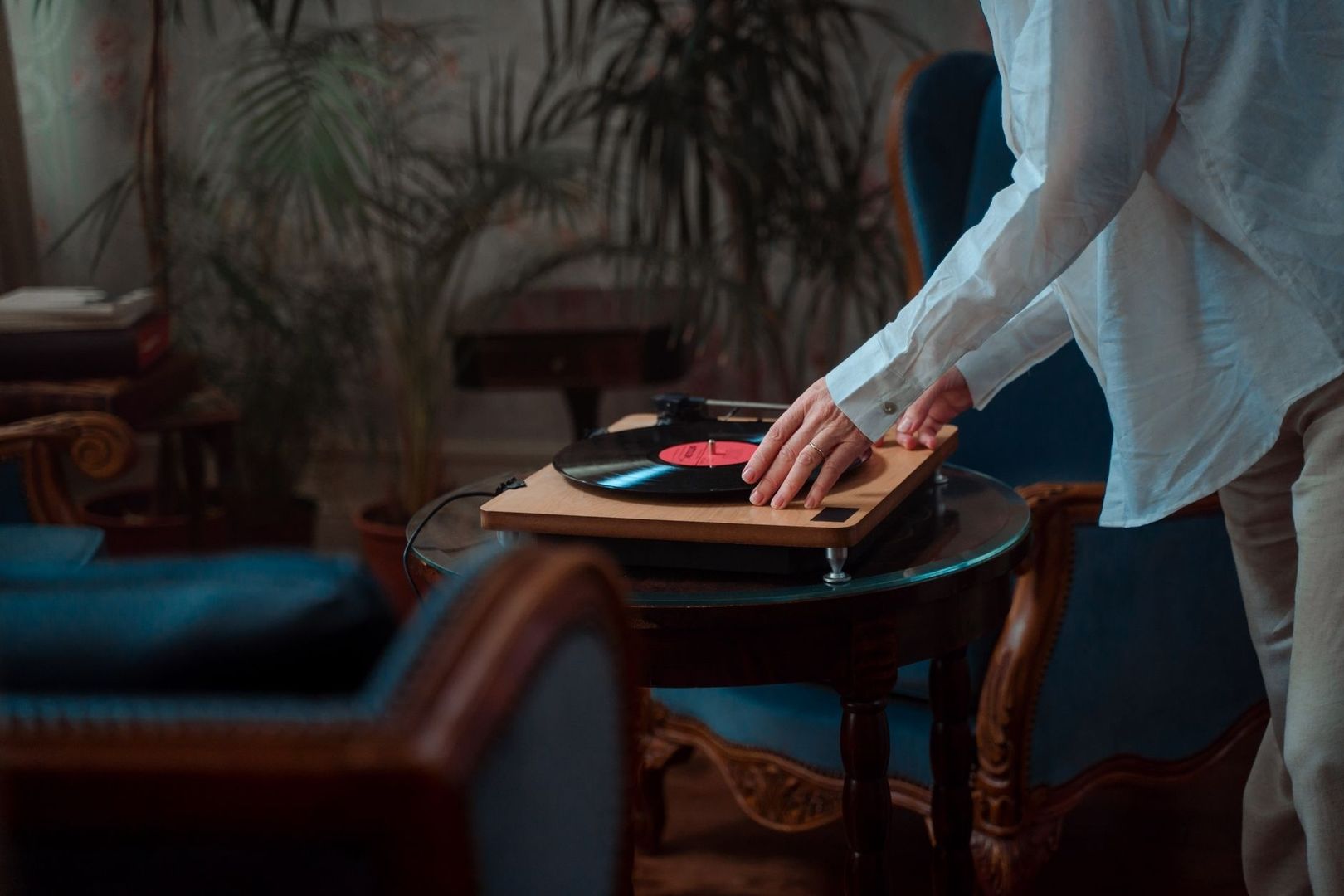
Why Our Fragmented Ears Need the Long Playing Record Again
Streaming has made nearly every recorded sound available, but availability is not the same as attention. A recommendation feed can move from a new single to an archival classic, a live version, and an algorithmically adjacent playlist before the opening texture of any one track has properly registered. Hyper-accelerated skip culture turns listening into selection, comparison, and dismissal. The ear is kept busy, yet the mind is rarely allowed to settle.
That constant track hopping also weakens the narrative force of recorded music. Albums are not merely containers for individual songs. Their running order, silences, tonal contrasts, transitional passages, and recurring motifs create an arc that can disappear when tracks are shuffled or sampled in isolation. Returning to full-album playback is therefore more than an exercise in nostalgia. It is a cognitive and aesthetic reset, a decision to let music occupy time without asking it to compete with every other stimulus. For listeners exhausted by automated abundance, one uninterrupted record can feel like a room with the door closed.

Pauline Oliveros and the Discipline of Sound Awareness
Pauline Oliveros gave this kind of attention a precise vocabulary. Her distinction between hearing and listening remains foundational: hearing can happen involuntarily, while listening is an active choice to attend. Deep Listening expands that choice beyond the obvious musical signal. It asks the listener to notice the entire field of sound, including environmental noise, resonance, silence, bodily sensation, memory, imagination, and the thoughts that arise while listening.
The practice took shape through Oliveros’s encounters with unusual acoustic environments, including the resonant underground cistern at Fort Worden in Washington State, where the Deep Listening Band recorded and performed in 1988. The long reverberation of that space made sound impossible to treat as a sharply bounded object. Tones lingered, blended, and returned as part of the architecture. From there, Oliveros developed exercises, sonic meditations, bodywork, breath practices, improvisations, listening journals, and composed pieces that treated attention itself as a creative medium.
This approach does not require specialist musical training. It is available to the collector studying a revered pressing, the musician tracing a chord voicing, and the listener noticing the refrigerator hum beneath a quiet ambient passage. The central discipline is deliberate presence. A session can involve broad attention to the room, followed by narrow attention to a single instrument, vocal breath, tape texture, or decay. The listener is not simply receiving music but learning how perception moves.
- Hear the whole field: include the room, the equipment, environmental sounds, and the spaces between events.
- Shift focus deliberately: move from the full mix to one voice, rhythm, timbre, or reverberant tail.
- Return without judgment: when attention wanders, notice it and come back to the sound.
- Allow duration to matter: do not treat silence, repetition, or slowness as material to skip.
For readers who want to explore the practice beyond a single listening session, The Center For Deep Listening continues the archival, educational, and community work connected with Oliveros’s legacy. Its importance lies in showing that Deep Listening is not a slogan for attentive audiophiles but an evolving practice that includes performance, meditation, collaboration, and everyday acoustic awareness.
The Cognitive Warfare Between Algorithmic Shuffles and Cohesive Art
The modern streaming interface rewards immediate adjustment. Skip, replay, queue, shuffle, search, and recommendation systems place control at the fingertips, which is useful when discovering music but corrosive when every moment is judged against an imagined better option. Cohesive albums operate differently. They ask the listener to accept an artist’s pacing, including the instrumental interlude, the unresolved transition, the low-volume passage, and the track that earns its force only after what came before it.
Music also recruits more than the auditory system. A major review of music and neuroplasticity describes interactions among auditory, motor, emotional, memory, reward, and attention-related networks. That does not mean a full-album session automatically repairs concentration or produces a measurable therapeutic effect. It does suggest why attentive listening can feel physically and emotionally involving, especially when a record develops patterns that the brain learns to anticipate and reinterpret. Research on preferred background music offers a useful distinction: in a sustained-attention task, self-selected music increased reported task-focused states mainly by reducing mind-wandering, although it did not significantly improve overall reaction time or reaction-time variability. The findings are detailed in The effect of preferred background music on task-focus in sustained attention. Music can shape attentional conditions, but it is not a universal performance enhancer.
| Passive ambient streaming | Deep album immersion |
|---|---|
| Music is selected for convenience, mood, or continuity. | Music is selected as a complete work with an intentional sequence. |
| Frequent skipping removes friction and weakens tolerance for development. | Duration, contrast, and delayed resolution become part of the experience. |
| Listening often shares attention with messaging, browsing, and other tasks. | The listener protects a defined period for sound alone. |
| Individual tracks dominate, while transitions may disappear. | Interludes, reprises, silence, and production choices retain their structural role. |
| The next recommendation remains mentally present. | The current record is allowed to become the complete environment. |
The contrast is not a moral battle between vinyl and streaming. A carefully configured digital file can support profound listening, while a record can be played inattentively. The decisive factor is the listener’s relationship to time. Deep listening replaces constant optimization with commitment. That commitment creates room for musical architecture to become legible, from the placement of a drum entrance to the emotional weight of a final refrain.
Curating an Uninterrupted Sonic Ritual in the Modern Home
A serious listening session begins before the stylus touches the groove or the first digital sample plays. Remove the screen from the center of the room. Put the phone on silent or in another space, disable autoplay, and decide in advance which album will receive the hour. If physical media is involved, prepare the record, clean the stylus, check the tracking setup, and keep the sleeve nearby for credits and sequence information. If the source is digital, use a stable playback system and a queue that contains only the chosen release.
High fidelity matters, but ritual matters more than price. A modest system in a quiet room can reveal more through concentration than an expensive chain used as background decoration. The aim is to reduce friction without turning listening into equipment maintenance. Set a comfortable volume that preserves dynamics, dim unnecessary lighting, and choose a position that allows the music to occupy the room. Avoid reading reviews during the session. The record should arrive without an interpretive escort.
- Choose one complete release: select an album with a deliberate sequence, whether it is familiar or entirely new.
- Remove competing inputs: silence notifications, close other applications, and keep the phone outside immediate reach.
- Listen through the opening movement: resist the first impulse to judge the record by a single track or production detail.
- Track the changing field: notice entrances, exits, silence, density, vocal placement, bass movement, and shifts in perspective.
- Let distraction pass: when the mind reaches for another stimulus, acknowledge the impulse and return to the music.
- Finish before evaluating: allow the final sound to decay, then consider what the complete arc changed about the individual tracks.
Complex records often become rewarding precisely where instant gratification fails. A low-energy passage may establish the scale needed for a later climax. An apparently slight transition can reset the ear before a new harmonic world arrives. Repeated listening makes these decisions more audible. Melodies, rhythmic figures, chord progressions, vocal phrasing, pauses, and production details move from the surface into musical memory. For musicians, this can sharpen the understanding of arrangement and expression. For everyone else, it deepens the sense that a record is built rather than merely assembled.
Start with twenty uninterrupted minutes if an hour feels unrealistic. The discomfort is useful information, not a reason to abandon the practice. Deep listening is not a demand for perfect concentration; it is the repeated act of noticing distraction and returning. Over time, the interval expands, and the album’s internal clock begins to replace the feed’s restless tempo.
Essential Catalog Masterpieces Built for Total Immersion
The strongest full-album candidates are not limited to one genre or format. They are releases whose meaning depends on pacing, atmosphere, and accumulation. Pauline Oliveros’s own Deep Listening recordings reward attention to resonance and collective space. Brian Eno’s ambient catalog invites the ear to follow gradual change rather than obvious hooks. Can’s Future Days turns repetition and drift into a fluid environment, while Talk Talk’s Spirit of Eden makes silence, dynamic restraint, and sudden orchestral force inseparable from the album’s identity.
- Avant-garde and ambient works: Oliveros, Brian Eno, Éliane Radigue, and Stars of the Lid reward patience, subtle timbral change, and close attention to decay.
- Progressive and art-rock concepts: Pink Floyd’s The Dark Side of the Moon, King Crimson’s Red, and Talk Talk’s Spirit of Eden depend on sequence, contrast, and studio architecture.
- Emotionally continuous song cycles: Sufjan Stevens’s Carrie and Lowell and The Antlers’ Hospice gain force through cumulative narrative and recurring emotional pressure.
- Story-driven hip-hop: Kendrick Lamar’s good kid, m.A.A.d city uses skits, voices, dense writing, and cinematic transitions to build a world larger than any single track.
- Classic vocal and orchestral drama: Simon and Garfunkel’s Bridge Over Troubled Water demonstrates how sequencing can move from intimacy toward release without sacrificing clarity.
These records represent different listening demands. Some ask for attention to spatial design and microtonal drift; others depend on lyrics, recurring characters, or emotional escalation. What unites them is the disappearance of detail when the album is reduced to isolated highlights. A transition can change the meaning of the next chorus. A quieter track can make the following performance feel physically larger. Even a record selected for solitary melancholy, comfort, or calm can hold a carefully engineered balance between lyrical momentum and sonic space.
Collectors should also resist the idea that the most expensive pressing automatically delivers the deepest encounter. A clean original edition, a well-mastered reissue, or a lossless digital release can each serve the music when the playback chain is stable and the listener is present. The important catalog question is not simply which format sounds best in a specification sheet. It is which edition makes it easiest to honor the work from first track to last.
Drop the Needle and Reclaim Your Mental Space
Deep listening offers a practical form of resistance to automated digital fatigue. It does not require abandoning streaming, rejecting discovery, or pretending that earlier listening cultures were free of distraction. It requires setting a boundary around one work and allowing that work to unfold without constant negotiation. In Oliveros’s terms, attention can widen to include the room and narrow toward a single sound, but it remains chosen rather than commandeered by the interface.
Tonight, dedicate one uninterrupted hour to a single album. Put the phone away, choose a comfortable volume, and begin at the beginning. Stay through the difficult passage, the transitional track, the silence, and the final fade. The reward is not merely a more complete understanding of the release. It is the recovery of mental space in which musical time, emotional memory, and attentive presence can meet again.